A Pernicious Problem
November 30, 2025
I need a plan to solve a pest-related problem at FECO. So, I gathered more information and thought 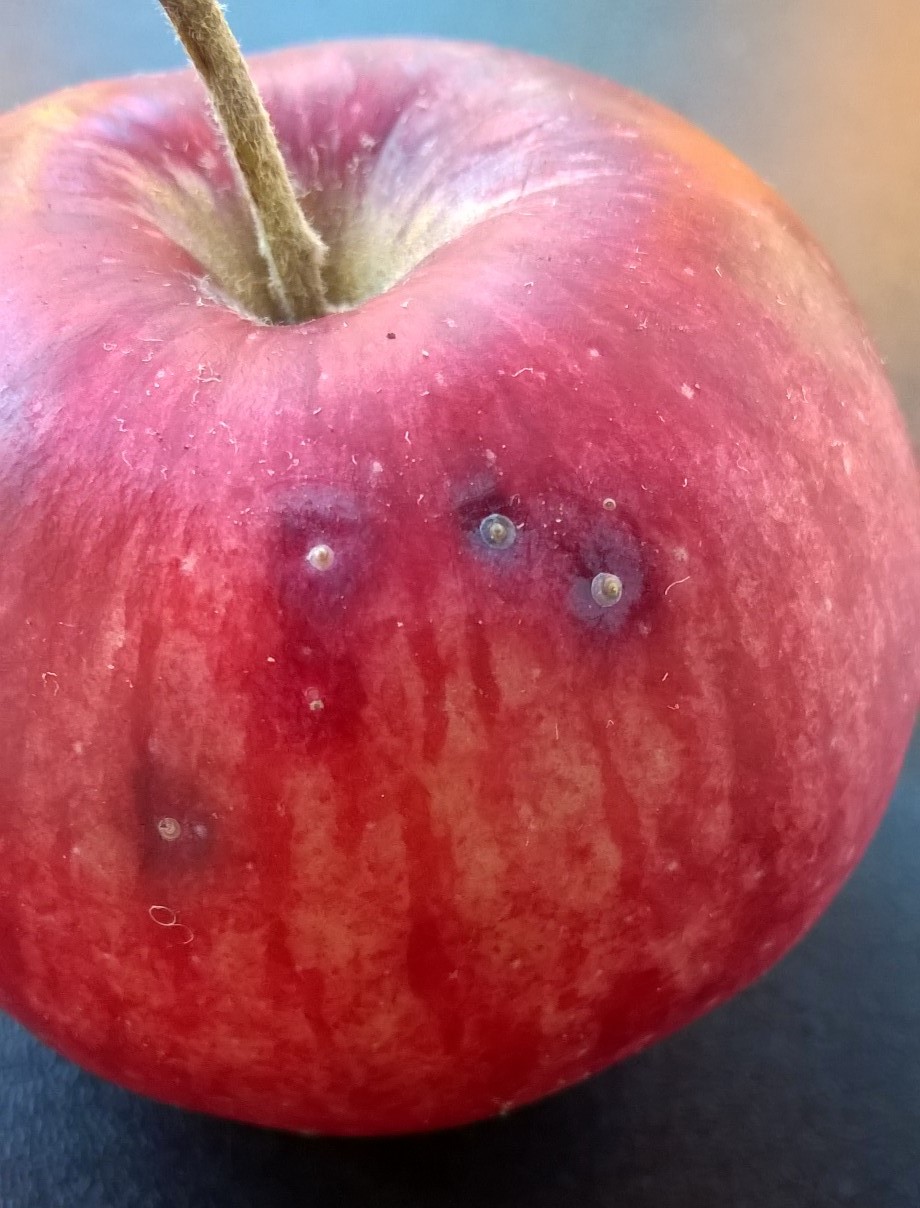 through alternative strategies – a good exercise for problem solving in general!
San Jose scale (SJS) is a hemipterous (true bug) insect (Comstockaspis perniciosus). Perniciosus … get it? SJS is among the most invasive insects in the world, and can easily be spread via plant stock. Orchards the world over are impacted by this tiny bug. (In the apple photo, the insect is under the little white dot that is surrounded by a pink halo.)
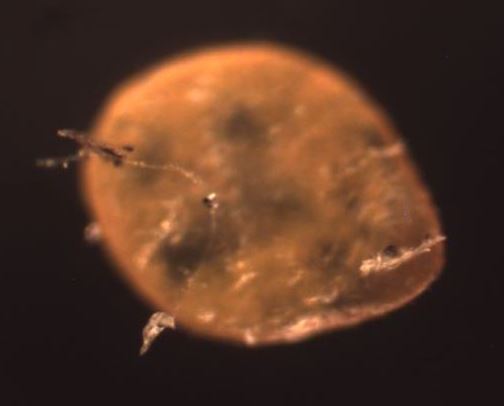 I first noticed San Jose scale (SJS) on our William’s Pride apple tree in 2023. This year I noticed at least some SJS in all of the apple trees. (My photo of the female is at 100X magnification.
I came up with six strategies to deal with this pest problem.
One. Do nothing. Isn’t this an appealing strategy? However, if scales become abundant, they can kill fruit spurs and limbs and cause trees to decline or die. The young scales are called crawlers because they crawl over the surface of the tree, insert their mouth parts through the bark, fruit or leaf, and suck the nutritional sap.
for work parties
Please email to volunteer
freewayestatescommunityorchard@gmail
Two. Let someone else take care of the problem. In this situation, that ‘someone’ would be predators provided by Nature. Another appealing strategy. Unfortunately, it is unlikely that we have enough lacewings, parasitical wasps and predacious beetles on site. Plus, the reproductive capability of this pest is astonishing. The literature, as far as biological predators are concerned, shows that the only effective tool from Nature would be some species of entomopathogenic fungi. Well! Just how might we recruit and apply this fungi? (Entomopathogenic fungi are parasitic microorganisms capable of efficiently infecting insects. They penetrate the insect’s cuticle with infectious spores.)
Three. Ask your friends what they do and copy their strategy. I posted our problem to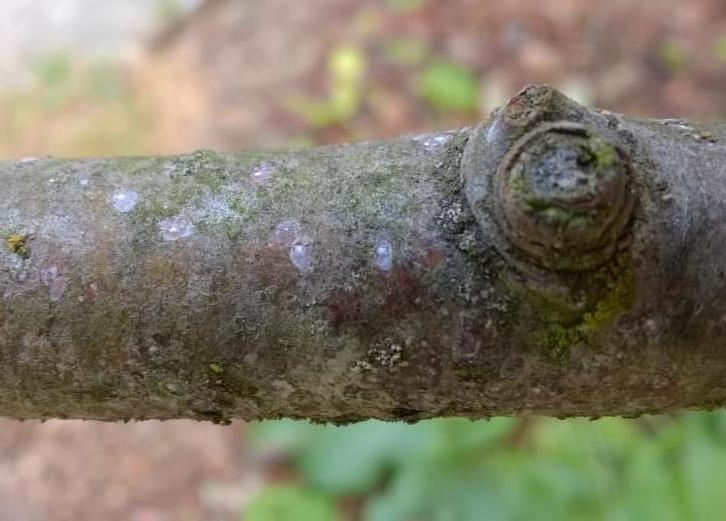
our nearby orchardists but I did not get one response. (Could be that they don’t know that they have SJS or, they feel they can live with their existing infestation.)
Four. Get heavy-handed! DDT? Sorry. Thankfully, it’s banned. Lime-sulfur spray and other synthetic pesticides? Not likely. This insect, via mutations, developed resistance to harsh chemicals. We need not consider these weapons; FECO only uses organic gardening methods.
Five. Eliminate the insurgent. Reports indicate successful control using high-pressure hosing (1,000 psi). Hmm. I don’t think the fire department owes us any favors at this time. However, I have thought of soaping up a toothbrush and washing all of the one-and two year old wood! I actually think this would work but it would take way too much time.
Six. Find a strategy that causes minimal harm. Apply horticulture oil. From a 2023 research paper (Katarzyna 2023), “Mineral oils for the control of scale insects are comparable in efficacy to chemical pesticides and even superior in terms of protection of natural enemies and the environment. The effectiveness of mineral oils is closely related to the timing of application.” (We would have to spray at specific times of the year, based on Degree Days, temperature and fruit tree phenology.)
“Fruits with ecologically based pest management are widely introduced and preferred by consumers, which reduces the use of chemical agents, and also the number of treatments, which gives priority to non-chemical control.”
Sold! Dormant oil will be our choice for tackling San Jose Scale. We will draw up a specific plan and start in late winter.
San Jose scale my not be relevant to your garden but I hope the strategies listed can help you with your current problem!
Ruth
References:
Approaches to Integrated Pest Management in Orchards:
Comstockaspis perniciosa (Comstock) Case Study
Katarzyna Golan , Izabela Kot
Agriculture Magazine, 2023, 13, 131.
https://www.cabidigitallibrary.org/doi/pdf/10.5555/20230051600
Identifying and Managing Critical Uses of Chlorpyrifos Against Key Pests
of Alfalfa, Almonds, Citrus, and Cotton
Univ. of California IPM, 2014
Click to access CDPR_Chlorpyrifos_critical_use_report.pdf
The San Jose scale. U.S. Department of Agriculture Division of Entomology Bulletin, 3, 32.
Howard, L. O., & Marlatt, C. L. (1896).
Click to access The_San_Jose_scale_and_its_control_%28IA_sanjosescaleitsc2124quai%29.pdf
San Jose Scale on Fruit Trees
Chelan County Horticultural Pest and Disease Board
Last Updated: 01/07/2015 11:15 AM
https://www.co.chelan.wa.us/horticultural-pest-and-disease-board/pages/san-jose-scale-on-fruit-trees
Quadraspidiotus perniciosus (Comstock), Order Homoptera, Family Diaspididae.
Contributions to the knowledge of the San José scale (Hemiptera, Coccomorpha, Diaspididae) in Poland
Katarzyna Golan, et. al.
Polish Journal of Entomology, Volume: 89, No.: 1, 2020
Wow! Thoroughly considered. Ready, set, tackle!
Thanks, Ruth!
In the picture they look very similar to tiny snails, I think.
Ecellent post! I’ve been thinking about what to do, so all the homework has been done for me. Dormant oil applications have to be timed just right; I expect the orchard community to be abuzz when it happens here.
Hi Ruth- I thoroughly enjoyed reading your take on SJS. It’s so pernicious!!!I see it on so many samples of apples each year. Some areas worse than others. SJS likes our PNW climate & I am leaning towards more of it in moister, shaker areas. I’ve been reluctant to dormant spray and this season I will start with it. Thank you for your article. Lori