
Oh for Peat’s Sake! The Challenge of Selecting Planting Mediums
October 25, 2026
I recently read a book (Note 1) that generated a strategy for environmental healing:
First, believe that the environment can be fixed, second, do some little thing for the earth, third, celebrate your accomplishment and fourth, tell your friends!
The idea is – if many people shifted from a platform of fear to a focus on the opportunity for solutions, our collective interest and enjoyment of little environmental actions can create cosmic momentum to push us toward a new and different direction.
A friend recently gave me some common camas (Camassia quamash) and western colombine (Aquifolium formosa) seeds. I am ready to grab a plant tray, push the seeds into some kind of medium, cover the tray and set it out under a bush for the winter. In choosing my planting medium (often called substrate) I am thinking to ‘do some little thing for the earth’.
for work parties
Please email to volunteer
freewayestatescommunityorchard@gmail
Planting medium. So many types! So many recipes! In choosing my medium, my aim is to use sustainable inputs.
Propagation from seed is not my specialty but we can agree on a few things. The seeds need a cool moist environment to slowly break dormancy over the winter. If the medium is too wet, the seeds can rot. So, secondly, the medium needs air holes to provide drainage, oxygen and spaces for eventual root expansion.
I ask a lot of gardeners what type of medium they use for seed trays. Recently I asked a person at a native plant nursery what they use for seed-starting medium. “Peat.”, was the answer. I tried to remain expressionless but I don’t ever seem to be able to do that. This propagator could tell that more explanation was needed. “We buy only certified peat from Canada. They don’t harvest more than will be readily replaced.”
Hmmm. Peat takes a long time to accumulate. I looked into this certification process. Turns out, the certification has to do with your restoration efforts. The certified extractors make no claim that the peat will ‘grow’ back at the same rate that it is extracted.
The European Geosciences Union website indicates that the best restoration practice can result in the peatland being able to capture and sequester carbon 15 years after restoration. The peatmoss industry organization seems to justify their extraction by pointing the finger at the bigger peat degradation industries – agriculture, including forestry, both of which drain water from the peatland in order to grow other crops, including trees.
Back to our seed-starting medium.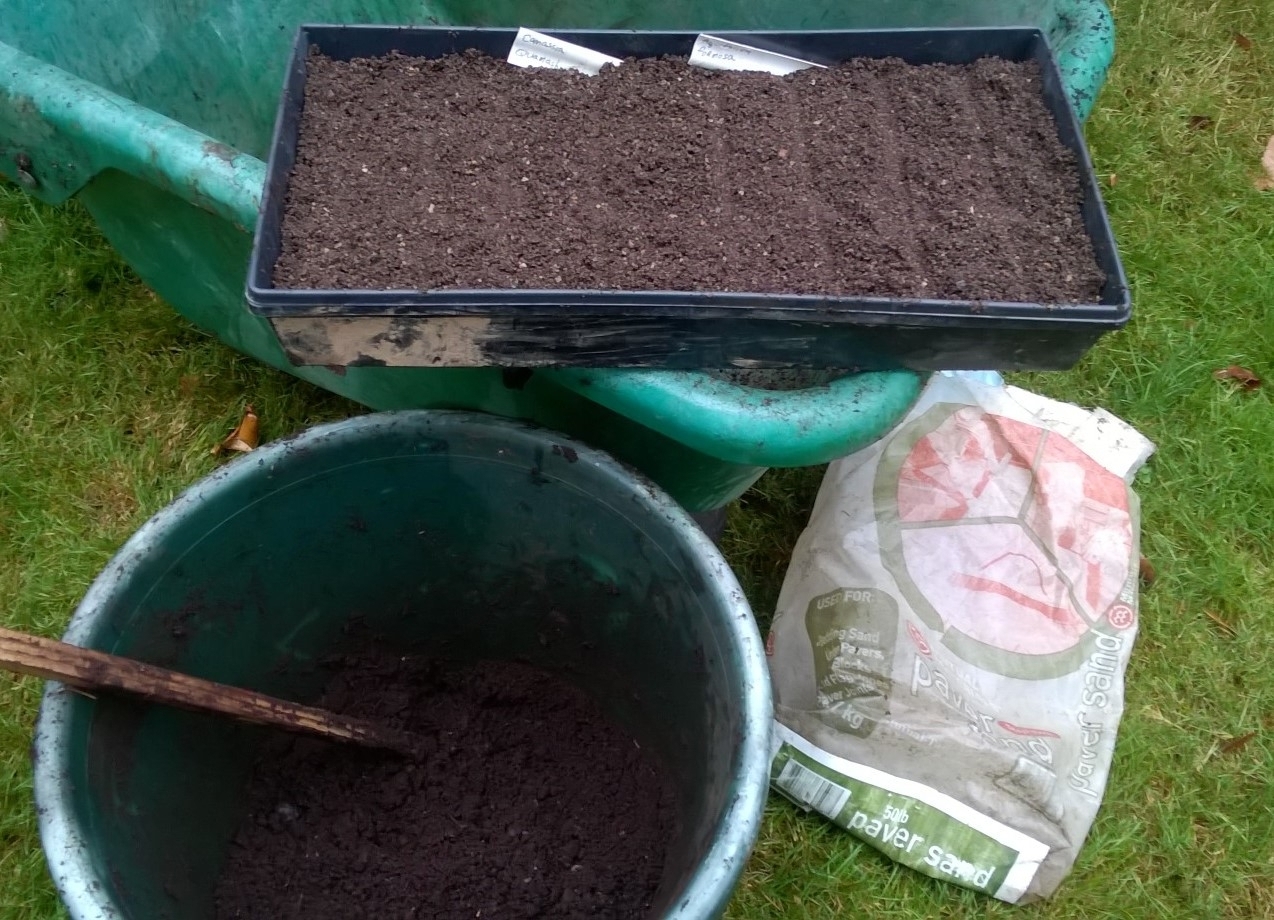
Inputs designed to create air holes: Perlite, Vermiculite, Sphagnum moss, pumice, builders sand, poultry grit, arborist chips, composted bark, rice hulls, among others. Perlite and Vermiculite are both mined and processed at a very high heat. The result is a high environmental cost.
Inputs designed to hold moisture: Peat, coco coir, leaf mold, compost, among others. Peat is classified as non-renewable – It takes 1,000 years for 1 meter of peat to accumulate. (Note 2) Coco coir is indeed an agricultural waste but requires a lot of water to wash the salts out, it’s a dusty operation, shipped from India, and is sometimes treated chemically due to high sodium and potassium levels.
Oh for Peat’s sake. As a local gardener, I don’t have the money-making pressure of a commercial grower! There is no reason why I can’t do my part for mother earth.
I stepped out into my backyard to see what I have on hand:
Some builder’s sand from a paving project – drainage and spaces.
I also made a bunch of mature leaf mold – moisture retention.
The medium doesn’t need nutrients because the seed provides everything until true leaves start to form in the spring. At that time I will tease out the little plants and look for a potting medium, at which time, I will again be looking for inputs that are local and more sustainable!
Ruth
Note 1 – Nature’s Echo: Harnessing Ancient Feedback Loops to Heal a Changing Planet
by Thomas Crowther, 2026.
Note 2 –
West Seattle Nursery carries – E.B. Stone Earth First Peat-Free Potting Soil. From their website: A premium 100% peat-free mix ideal for indoor and outdoor plantings. It’s made from entirely natural and organic ingredients: aged bark fines, coir, pumice (rc surface-mined, no high heat), compost, earthworm castings, bat guano, and kelp meal. It improves moisture retention, adds air space for healthy roots, and is ready to use straight out of the bag. estimated at $20 for 1.5cf
Rosy Soil Seedling Seed Starter Mix
(Major retailers ship it to store)
Base: Pine bark fines, compost, sand, and biochar (designed to resist gnats).
This organic seedling starter soil combines nutrient-rich worm castings, root-boosting biochar, and beneficial mycorrhizae fungi. Rosy Soil mixes including seedling formulations are OMRI Listed and peat-free. estimated at $20 for 4 qt bag
Resources:
The persistent challenge of alternatives to peat in container-based horticulture: a historical review of the field of growing media
Siv Mari Aurdal
Frontiers in Horticulture, October 2025
https://www.frontiersin.org/journals/horticulture/articles/10.3389/fhort.2025.1657037/full
Peatlands
Department of Agriculture, Environment and Rural Affairs
https://www.daera-ni.gov.uk/articles/peatlands
Leaf Mold As An Alternative To Peat
Rosina Y. Rodighiero, Student Research Project, 2019
Kwantlen Polytechnic University, Department of Sustainable Agriculture and Food Systems
https://www.kpu.ca/agriculture/student-research/Rodighiero
Recent applications of peat resources utilization and its environmental impacts mitigation – A review
Kuokkanen , V., Kuokkanen , M., and Prokkola , H.
NC State University, BioResources Journal
https://bioresources.cnr.ncsu.edu/resources/recent-applications-of-peat-resources-utilization-and-its-environmental-impacts-mitigation-a-review/, 2026
Global Peatland Hotspot Atlas: The State of the World’s Peatlands in Maps
UN Environmental Programme
https://www.international-climate-initiative.com/fileadmin/iki/Dokumente/Publikationen/Projekte/18_III_096/20250515_UNE_global_peatland_hotspot_atlas.pdf
**UW Native Plant Propagation Protocals
https://jbakker.shinyapps.io/Protocols/
UW Native Plant Workbook Index Page
https://depts.washington.edu/propplnt/plantindex.htm
RNGR Propagation Protocols for Native Plants – Native Plant Network
https://npn.rngr.net/propagation/protocols
Leave a Reply
Want to join the discussion?Feel free to contribute!